"Excuse me, will your jewelry turn black?"
We are asked this question all the time.
Strange question?
How does jewelry 'turn black' and why is it one of the top concerns of many jewellery wearers?
Let's have a good crack at this issue.
The 'Black' Sheep
There is a variety of jewellery crafting techniques. Nonetheless the components involved are generally categorized into beads and 'other parts'.
Beads basically last very well although certain types are not colour fast. Others may react badly with chemicals or peel over time.
That said, it is the 'other parts' that are more likely to generate quality issues. And these issues usually arise from the use of metal.
The Enemy - Tarnish
Many metals tarnish. Tarnish is a layer of corrosion that develops over reactive or semi-reactive metals as they undergo oxidation.
Tarnish is somewhat like rust, but with a slower rate of occurrence. It is mainly caused by chemicals in the air and sweat.
Tarnish appears as a gray or black film over
the metal. When a piece of jewelery 'turns black', it is a result of tarnish
forming on its metal parts.
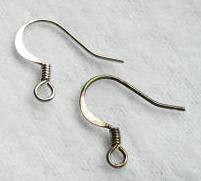
The photograph on the right shows two ear wires.
The ear wire on the left is new and looks shiny and bright. The one on the right shows how the ear wire will look after months of exposure to air and sweat.
A bad case of tarnish has developed and some say it has 'turned black'.
Plating as a Low Cost Solution
Often, modestly priced jewelry deal with the problem of metals tarnishing through plating - a thin coat of more inert and attractive looking metal applied to another base metal.
Plating varies widely in materials and quality. One drawback is that they will likely wear off through wear and tear. The good ones can last surprisingly long though.
When the plating wears off, the base metal beneath is thereafter exposed. Base metals may be dark colored or they may tarnish badly as their protection is gone. Again, in this instance, it has 'turned black'.
Tarnish caused by environmental chemicals
First of all, we all sweat differently. Chemical contents in sweat vary so widely among people, the contrast is startling.
We know of people who tarnish their silver jewellery within two hours with their perspiration.
All of us punish our jewelry differently according to what oozes out from the pores of our skin. So, along with the sweat and salts from our skin, the air, food and the various chemicals we routinely come in contact with all contribute to the encouragement for metals to oxidize.
Precious Metals as Solution
A solution in the realm of handcrafted jewelry involves precious metals - usually silver and gold.
Working with silver and gold alone will not satisfy us. There are so many varieties of metals and materials out there and they provide us with endless possibilities.
Rhodium Plating
Jewellery crafters, who choose to work with bright, shiny plated metal parts and wish to offer a higher quality product, often turn to an element known as rhodium.
A rare silvery-white hard metal, rhodium is a member of the platinum group.
Rhodium metal does not normally form an oxide, even when heated. It is the most expensive precious metal. Due to the price factor, it is generally utilized for plating only.
Jewelry parts (we call them findings) plated with rhodium is a lot more expensive.
Brilliant and gorgeous, they have an expensive look as well. Good quality rhodium plating continues to look wonderful even when subjected to harsh, environmental abuse.
All it needs is a little help through occasional wiping and polishing. But here's the caveat - good quality rhodium plating.
Strange Findings
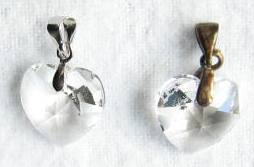
Both pendants on the left feature rhodium plated findings.
The one on the left is new and the one on the right has been subjected extensively to tarnish inducing chemicals.
It did not tarnish as easily as cheaper findings would but what happened to it is not normally expected of rhodium, and it was expensive.
4 Grades of Rhodium Plating
(our private ratings)
We sample every batch of findings we intend to craft into jewellery by testing the specimens intensively under varied conditions to predetermine their ability to resist oxidation and thus tarnishing.
With rhodium plating, we have categorized the different qualities we have encountered into four groups:
- Grade A – Do not tarnish at all.
- Grade B – Shows only traces of blemish. Very good,
considering the hell we put it through.
- Grade C – Turns yellowish or exhibit a mild case of
tarnish
- Grade D – 'turned black' although not as severely as cheaper materials would
Can't Count on Them. Can't
Count on Anything
What's very confusing and unsatisfying is that there are supposedly guiding factors to the quality of this form of plating:
- Price – higher prices should lead to better quality
- Specification – those with better specifications
should offer better quality
- Source – some countries are reputed to make them better
- Factory – if a number of products from a factory were
tested to be good, others should showcase similar qualities
- Comments from experienced sources – suppliers confidently assuring certain batches of goods are really top quality
All the factors above are unreliable. We can never tell if we have purchased a gem or a dud. We can't tell because they all look great, rhodium great.
Testing Shows Us the Truth
Putting them through rigorous tests is the only way to see their true colours.
Agalil's quality policy is to use rhodium plated findings of Grade A and B only. This yardstick applies to all other bright and shiny type of plated materials – they must be resistant to oxidation as well as Grade B rhodium plating at the minimum.
Enameling
Another solution is enameling.
Enamel plating will prevent oxidation as long as the plating is in place. The key is in discovering strong, quality enamel plating.
Summary
Many quality issues lie with the metal components.
How long your jewelry lasts, rests with how well the metal parts resist tarnishing.
Return to Jewelry Information
Return to Agalil Sea Life Jewelry Home Page
We accept